Menu
DENTAL WEB DESIGN / GRANITELOOP
Web Design for Dental Practices
A dental website has to lower uncertainty without overstating care. Prospective patients need to understand the practice, treatments, providers, payment context, location, and next step in a calm, accessible experience.WHO THIS IS FOR
01
Build trust through useful information
Patients bring different levels of familiarity and concern. Service pages should explain what the practice offers, who it may help, what a visit generally involves, and where the website should defer to a clinical conversation.
Provider profiles, practice philosophy, real credentials, location details, and first-visit guidance can make the experience feel more concrete without making claims the practice cannot support.
- Treatment and service information
- Provider and team presentation
- New-patient and first-visit guidance
- Location, hours, and contact information
02
Create a responsible appointment path
Appointment and contact flows should ask for the minimum information needed to begin a conversation. Sensitive clinical details do not belong in an ordinary website form unless the system, policies, and vendors are designed for that responsibility.
GraniteLoop can connect an approved scheduling or practice tool when its capabilities and access are clear. Otherwise, the site can provide a controlled request flow with truthful expectations.
- Mobile-friendly contact and appointment actions
- Broad, non-clinical request categories
- Insurance and payment information structure
- Clear emergency and privacy boundaries
03
Accessibility and mobile usability are core requirements
Readable type, strong contrast, visible focus, labeled controls, meaningful headings, and comfortable touch targets help more people use the site and make the experience easier for everyone.
Responsive design is more than shrinking a desktop layout. Navigation, service discovery, provider content, directions, and appointment actions need a deliberate phone-sized hierarchy.
04
Measure the path without making promises
Analytics can show which pages lead to calls or appointment requests and where visitors leave the path. Those signals support iteration, but they do not justify invented patient outcomes or guaranteed growth claims.
Search foundations include structured content, unique metadata, canonicals, crawlable links, performance work, and accurate local information supplied by the practice.
Juniper Row Dental
A clearly labeled concept build demonstrating patient-centered information architecture, accessible responsive design, provider trust, service discovery, and a safe appointment-request boundary.
View case study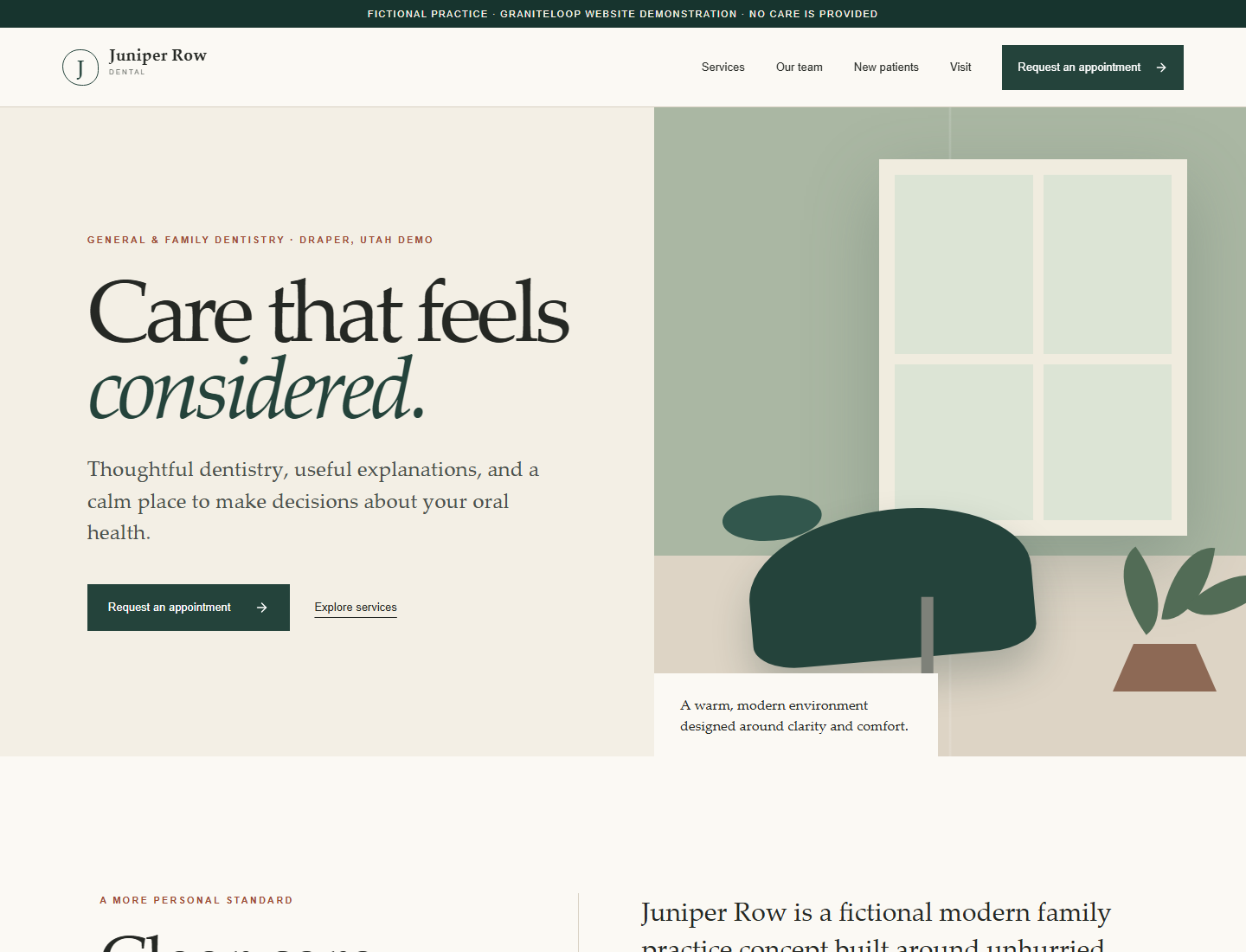
THE PROCESS
From business need to working system.
- 01Understand the practice, patient questions, and boundaries
- 02Plan service, provider, location, and patient-information routes
- 03Design a calm, accessible responsive system
- 04Build and test contact, scheduling, analytics, and metadata
- 05Launch with clear content ownership and support
USEFUL NEXT STEPS
Go deeper where it helps.
START WITH THE REAL BUSINESS NEED